

Tenant experience is often discussed in terms of tone and impression, and can be difficult to measure. In practice, what matters most is creating open lines of communication, how issues are logged and how clearly, they are dealt with as they move toward resolution. This doesn’t require a substantial shift in strategy, rather consistency, applied across every unit in a portfolio rather than only the occupiers who attract the most attention in a given week. This guide sets out the practical measures that make the greatest difference, drawing on what we observe across the retail and mixed-use destinations on the Kinexio platform.
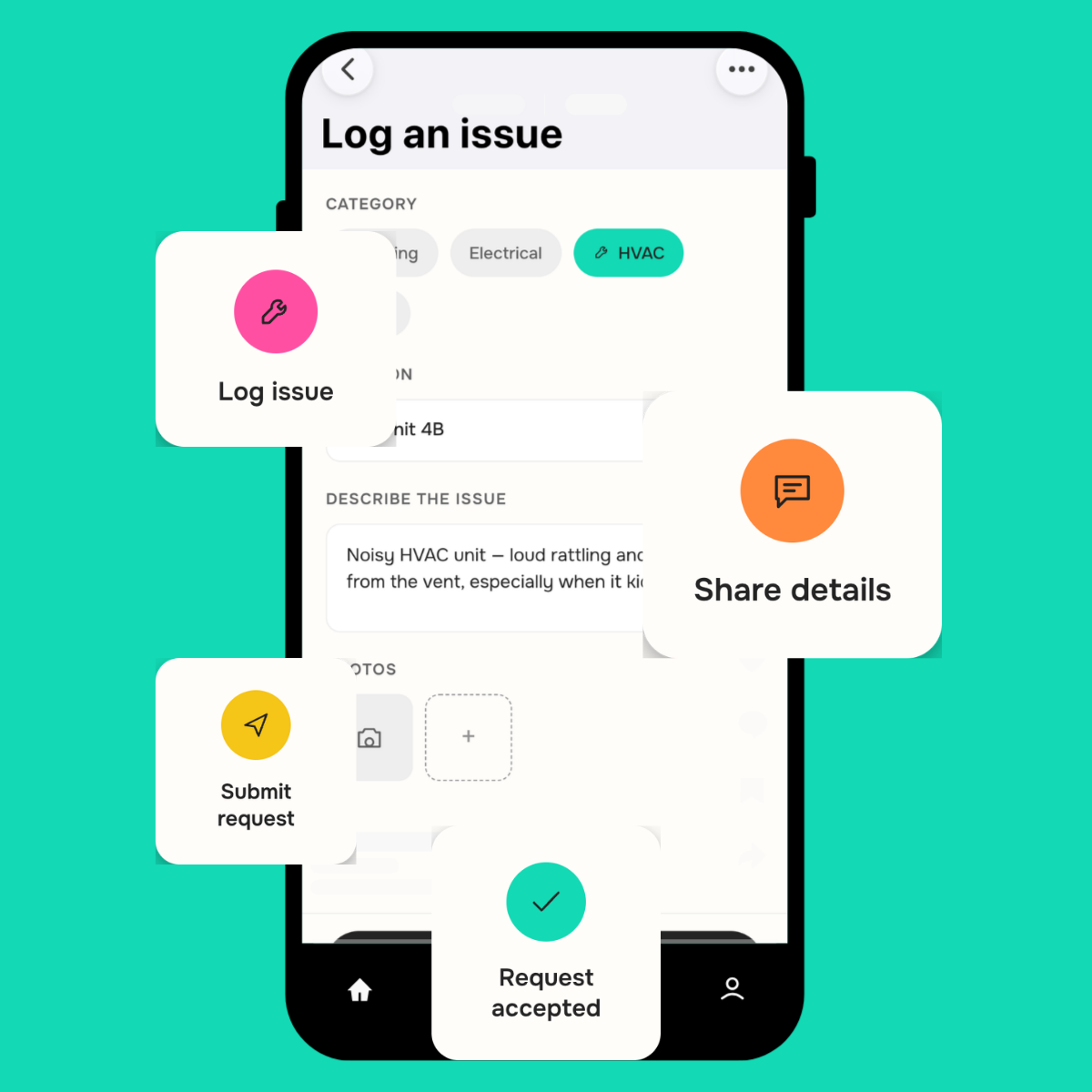
Every issue belongs in the system
A minor complaint about a noisy HVAC unit or a significant security fault belong within the same system, even though they clearly do not carry equal urgency. Where small requests are handled informally, through a phone call or a message that is never logged, they contribute nothing to the wider picture of how a building is performing. Capturing every request, however minor, creates a complete record that property teams can draw on later, both for reporting purposes and for justifying capital investment. It also protects a property team should an occupier later raise a concern that an issue was never addressed. Occupiers are also more likely to use the same channel consistently when it is already familiar to them from other communication, such as event updates or building information, rather than defaulting to an email or phone call that is never captured in the system. A consistent log is the foundation on which everything else in this guide depends.
Acknowledgement matters as much as resolution
Resolution time tends to receive most of the attention, yet acknowledgement time has a comparable bearing on how a delay is perceived. An occupier who hears nothing for two days after logging a request is likely to assume it has been overlooked, even where it is eventually resolved within a reasonable period. An occupier who receives confirmation within minutes, together with an indication of when to expect an update, experiences the same delay very differently. Acknowledgement need not include a solution. It only needs to confirm that a request has been received and is being addressed, which is often sufficient to prevent frustration accumulating while the work is scheduled. That acknowledgement also carries greater credibility when it comes from a channel an occupier already recognises and trusts for other communication, rather than one that only ever makes contact when something has gone wrong.
Communication should continue throughout a request
Many operations teams communicate well at the outset of a request and again once it is closed, with less consistency in between. That gap is where confidence in the process is most likely to weaken on anything that takes more than a day or two to resolve. A brief update confirming that a contractor has been booked, or that a part is on order, requires minimal effort and provides meaningful reassurance that progress is being made. Where those updates arrive through the same channel an occupier already uses for building information or event notices, they read as a natural extension of an existing relationship rather than an unfamiliar interruption, which makes them easier to notice and act on. Where a request will genuinely take longer than expected, communicating this early is almost always better received than silence followed by a late explanation.
Routing issues efficiently
Every additional handoff between teams introduces delay and increases the likelihood that a request is lost or duplicated. A request manually passed between a reception desk, a property manager and a contractor before anyone reviews it will typically take longer to resolve than one routed automatically to the right person from the outset. Reducing the number of steps between an occupier raising an issue and the right person seeing it has a direct effect on resolution time and an equally direct effect on the cost of resolution, since fewer people are required to relay information between one another. It is also important that the correct people get the right information that they need, preventing overwhelm. Routing also works best when the platform already holds a clear picture of the occupier, built through the other communication that runs through it, rather than each request being handled without that wider context.
Ticket data reveals patterns in the asset
A single request is a service matter. Repeated requests concerning the same piece of equipment, or the same area of a scheme, point to something more significant about the underlying asset. Reviewing ticket data in aggregate, rather than only on a case-by-case basis, surfaces these patterns early enough to address them through planned maintenance rather than repeated emergency works. This is where operational data delivers value beyond the immediate occupier relationship. A scheme that resolves the same fault four times in a year is, in effect, paying for it four times over, both in contractor costs and in occupier goodwill. Reviewed alongside broader engagement data, such as how actively an occupier is using the platform for marketing or event information, ticket patterns also help distinguish an isolated asset problem from a wider decline in that occupier’s engagement with the scheme.

Operations is one part of a wider communication picture
Operations represents only one strand of a much wider communication picture, and the two reinforce each other in practice rather than functioning as separate activities. The same platform that logs and resolves a maintenance request can also carry marketing updates and event promotion, giving occupiers a reason to engage with it that has nothing to do with a problem. It can carry job listings and sales data collection, information that supports an occupier’s own business as much as the landlord’s, alongside general building information and the critical or emergency communication that occupiers need to receive quickly and reliably.
The breadth of this contact matters as much as its consistency. An occupier who receives relevant, useful communication through a platform on a regular basis is more likely to engage with it when an operational issue arises, which supports faster acknowledgement and clearer reporting. The reverse also holds. An occupier whose operational issues are handled quickly and communicated clearly is more inclined to open and act on the marketing, events or building information that arrives through the same channel, rather than disregarding it as an unwanted or irrelevant form of contact. This kind of engagement, built through everyday contact rather than only through operational necessity, compounds over time in a way that reactive communication on its own cannot replicate. It is this accumulated engagement that ultimately translates into stronger relationships and more resilient asset performance.
None of these practices is complex in isolation. What makes the difference is applying them consistently, across every request and every occupier, rather than only once a problem has already escalated. Done well, this combination of responsive operations and broader platform engagement has a measurable effect on both occupier experience and financial performance, from lower reactive maintenance costs to stronger conversations at the point of renewal. This is consistent with the pattern observed across the retail and mixed-use destinations on the Kinexio platform, where the schemes with the strongest operational discipline and the broadest use of the platform are consistently the ones that build the strongest relationships with their occupiers.
This is consistent with the pattern observed across customers on the Kinexio platform, where the schemes achieving the strongest renewal outcomes are consistently those in which issues are resolved quickly and occupiers are kept informed as a matter of routine, not only in the run-up to lease expiry. Lease negotiation is frequently treated as a purely financial exercise. In practice, operational history is one part of a wider picture, and the landlords who manage that relationship well are the ones who arrive at the negotiating table already ahead.